Assessment at Barlby Primary School
At Barlby Primary School, assessment is an important part of teaching and learning. It helps teachers understand what children know, what they can do and what they need to learn next.
Our approach to assessment is purposeful and supportive. Assessment is used to inform teaching, identify gaps in learning and ensure that all pupils, including those with SEND and those who are disadvantaged, receive the support and challenge they need to make progress.
How We Assess Children
Teachers assess pupils continually through their day-to-day teaching. This includes:
-
questioning and discussions
-
observing pupils during lessons
-
reviewing work in books
-
quizzes and retrieval activities
-
phonics and reading assessments
-
independent tasks
-
more formal assessments at key points during the year
Teachers use this information to adapt teaching, provide additional support where needed and ensure that pupils are appropriately challenged.
Assessment Across the Year
Pupil progress is reviewed regularly throughout the school year. Teachers and school leaders use assessment information alongside children's work and their knowledge of each individual pupil to build a clear picture of attainment and progress.
Pupil Progress Meetings are used to identify strengths, gaps in learning and pupils who may benefit from additional support or intervention.
Assessment information is also shared with parents through Parents' Evenings and end-of-year reports.
Early Years Foundation Stage
In the Early Years, assessment is based primarily on what practitioners observe children doing independently through their learning and play.
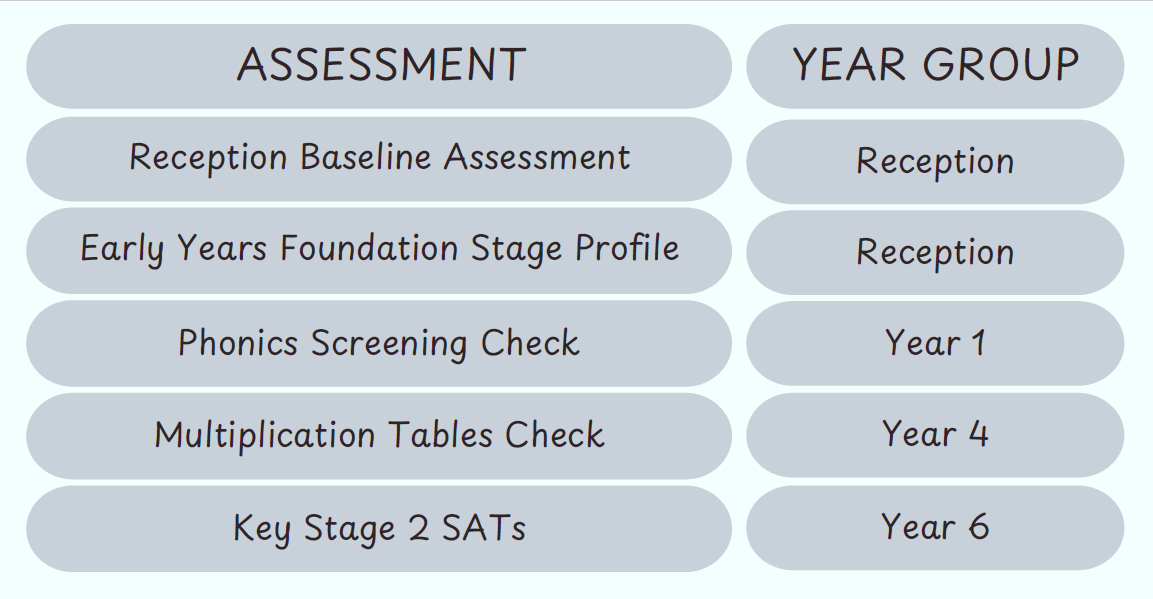
At the end of Reception, children are assessed against the Early Learning Goals (ELGs) as part of the Early Years Foundation Stage Profile.
Phonics
Children's phonics knowledge is assessed regularly using our Little Wandle Letters and Sounds Revised programme. These assessments enable staff to quickly identify gaps and provide additional practice.
At the end of Year 1, pupils take the statutory Phonics Screening Check. Pupils who do not meet the expected standard usually retake the check in Year 2.
Key Stage 1
Teachers use ongoing assessment throughout Years 1 and 2 to monitor children's attainment and progress in reading, writing and mathematics, alongside the wider curriculum.
This information supports teachers in planning appropriate next steps and preparing pupils for the demands of Key Stage 2.
Multiplication Tables Check
Children in Year 4 complete the statutory Multiplication Tables Check (MTC). This online assessment checks pupils' fluency in recalling multiplication facts up to 12 × 12.
Key Stage 2 SATs
At the end of Year 6, pupils take the statutory Key Stage 2 national curriculum tests (SATs).
Children are assessed in:
-
English reading
-
English grammar, punctuation and spelling
-
mathematics
Writing is assessed by teachers using children's work across the curriculum.
Supporting Every Child
Assessment is not simply about test scores. We recognise that every child is different and may demonstrate their learning in different ways.
For pupils with SEND, assessment is considered alongside their individual needs, starting points and personalised targets. Where appropriate, reasonable adjustments are made so that pupils can demonstrate what they know and can do.
Our aim is to ensure that assessment supports excellent teaching, celebrates children's achievements and helps every pupil make the best possible progress.